Sound Reshaping Sleep
Contents
Introduction: An Overlooked Fact 1. Neurobiology of Sleep: Slow Waves Are the Core 2. Sound and the Brain: The Physiology of Neural Coupling 3. How Closed-Loop Acoustic Neuromodulation Works 4. Full-Night Sleep Management: From Falling Asleep to Deep Sleep 5. Fundamental Differences from Music-Based Products 6. Scientific Evidence and Technical Boundaries Conclusion: A New Philosophy of Sleep Intervention ReferencesIntroduction: An Overlooked Fact
Humanity spent decades researching sleep medications while overlooking a fundamental fact: sleep is not the passive disappearance of consciousness, but a highly organized neural program actively executed by the brain.
During deep sleep, tens of billions of cortical neurons discharge in precisely synchronized rhythms, forming spectacular slow-wave oscillations. This process requires neither conscious participation nor voluntary control — it is driven entirely by neurophysiological principles. For this reason, attempting to intervene in deep sleep structure through emotional means (such as music relaxation) is like trying to influence your heartbeat rhythm through mood — the pathway is indirect and limited.
Aika Lab's Closed-Loop Acoustic Stimulation (CLAS) technology takes a different approach: engaging directly with the brain's neural oscillation dynamics, delivering precisely timed sound pulses through the auditory-cortical-thalamic circuit to actively participate in shaping sleep architecture.
1. Neurobiology of Sleep: Slow Waves Are the Core
1.1 Sleep Is Not Uniform
Human sleep is divided into non-rapid eye movement (NREM) and rapid eye movement (REM) sleep, with NREM further subdivided into N1 (sleep onset transition), N2 (light sleep), and N3 (deep sleep). N3, also known as Slow-Wave Sleep (SWS), is the cornerstone of sleep quality and the stage most vulnerable to loss in modern life.
1.2 Slow Oscillations: The Physical Essence of Deep Sleep
The hallmark of N3 deep sleep is cortical slow oscillations (SO), with a frequency of approximately 0.5–1 Hz. This is not an abstract statistical metric but the real electrical activity of cortical neurons:
- UP phase: Billions of cortical neurons synchronously depolarize, producing large-scale excitatory discharge.
- DOWN phase: Neurons collectively hyperpolarize, entering deep inhibitory silence.
This alternating rhythm is considered the brain's "self-maintenance program." During the UP phase, the hippocampus transfers memory fragments accumulated during the day to the cortex. During the DOWN phase, synaptic strengths are recalibrated and metabolic waste is cleared. Research suggests this process may be linked to the glymphatic system's clearance of neurotoxic substances such as β-amyloid protein (Xie et al., 2013, Science).
The quality of slow waves — amplitude, synchrony, and duration — directly determines the restorative effectiveness of deep sleep. This is the target of Aika's technology.
1.3 The Modern Slow-Wave Crisis
Research shows that from age 25 onward, slow-wave oscillation amplitude gradually declines with age. Stress, irregular schedules, and screen blue-light exposure accelerate this decline. Losing deep sleep is more than "sleeping poorly" — it is closely linked to memory decline, metabolic dysregulation, immune suppression, emotional disturbance, and increased risk of neurodegenerative disease.
2. Sound and the Brain: The Physiology of Neural Coupling
2.1 The Special Position of the Auditory System
Among all sensory pathways, the auditory system has a unique connection with the brain. Sound signals travel from the outer ear through cochlear frequency decomposition, auditory brainstem temporal processing, thalamic medial geniculate nucleus (MGN) information gating, to the primary auditory cortex (A1), and finally through association cortex for cross-regional synchronization.
Dense bidirectional connections exist between the auditory cortex and the prefrontal cortex, hippocampus, and thalamus. Sound is not merely "heard" but integrated into the oscillatory state of the whole-brain network. This means a carefully designed sound signal can influence distant cortical slow-wave dynamics through the auditory pathway.
2.2 Auditory Evoked Potentials: Neural Responses Triggered by Sound
When a transient sound signal reaches the auditory cortex, it triggers a series of measurable EEG responses called Auditory Evoked Potentials (AEP). During N3 deep sleep, stimuli delivered at specific timing can trigger K-complexes, which in turn initiate or enhance a new slow oscillation cycle. This is not interference but "resonance" — the sound pulse lands precisely on the stepping stone of the brain's own rhythm, helping slow oscillations continue more powerfully.
2.3 Phase Sensitivity: Timing Is Everything
There is a critical constraint: the enhancement effect only occurs when the acoustic stimulus lands near the peak of the slow-wave UP phase.
- Stimulus on UP phase: Slow-wave amplitude enhanced, deep sleep strengthened ✓
- Stimulus on DOWN phase: Interference produced, slow waves disrupted, possibly triggering arousal ✗
- Continuous audio (e.g., music): Phase information overwhelmed, net effect unpredictable ?
This characteristic dictates that any effective acoustic sleep intervention must be closed-loop and phase-aware, not continuously playing.
3. How Closed-Loop Acoustic Neuromodulation Works
3.1 Closed-Loop System Architecture
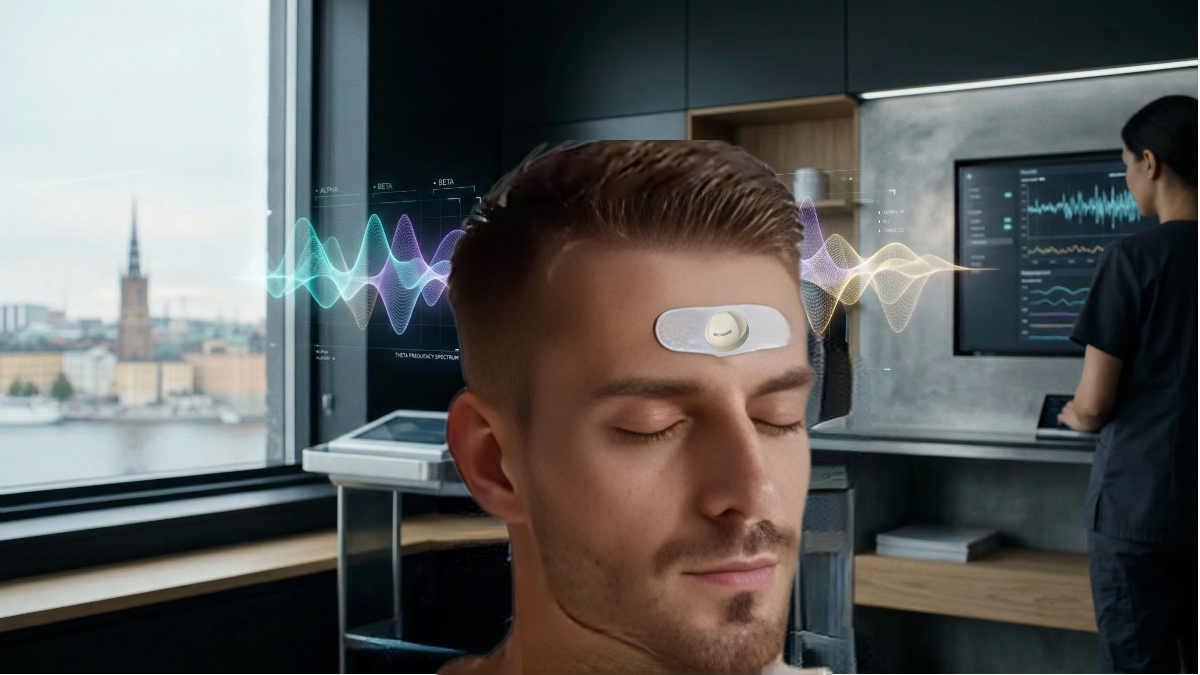
Aika Lab's closed-loop acoustic neuromodulation system operates on a real-time feedback architecture: the BCI sensor acquires EEG signals, real-time DSP processing (FFT/filtering) performs sleep stage classification, N3 confirmation triggers slow-wave detection, UP phase timing is predicted (40–50ms in advance), a precise sound pulse is delivered, and the brain's electrophysiological response is measured to adaptively adjust the next stimulation parameters.
Every sound emission is deliberate: the system detects N3 slow waves, predicts the next UP phase, and fires the pulse 40–50 milliseconds in advance to precisely hit the target phase window. The post-stimulus silence period (~2.5 seconds) is the system's data acquisition window for observing the brain's response, learning, and adjusting the next parameters. This silence is part of the algorithm, not a gap.
3.2 Why Pink Noise Pulses
Pink noise has a power spectral density inversely proportional to frequency (1/f characteristic), closely matching the spectral distribution of natural environmental sounds (rain, wind, flowing water). Three reasons underpin this choice:
Neural level: Pink noise generates broad-frequency, uniform neural responses in the auditory cortex, effectively triggering K-complexes with higher evoked efficiency than pure tones.
Adaptation level: The brain rapidly habituates to repeated pure tones, reducing response amplitude. The stochastic components of pink noise slow this adaptation process, maintaining stimulus effectiveness throughout the night.
Safety level: 50ms pulses are far below auditory damage thresholds, and brief enough not to trigger the complete "sound recognition" cognitive process that would cause arousal.
3.3 Thalamic Gating: The Neurophysiological Guarantee of Precision
During N3 deep sleep, the thalamus actively shields external sensory information — this is one function of sleep spindles, preventing external noise from disrupting deep sleep.
The system's pulse intensity is precisely calibrated: just enough to penetrate thalamic gating and trigger a slow-wave response, but insufficient to activate the full arousal circuit. This is an extremely narrow effective window. Continuously playing music forces thalamic gating open, pushing the sleeper toward lighter sleep; precise pulses ride the natural rhythm of the gate, completing intervention through the gaps.
4. Full-Night Sleep Management: From Falling Asleep to Deep Sleep
Closed-loop acoustic neuromodulation is not a technology that "only works after you're asleep." Aika's multi-phase algorithm covers the complete sleep arc from eyes-closed to morning.
4.1 Phase 1: Acoustic-Guided Sleep Onset
Objective: Guide neural oscillations toward lower frequencies, shortening sleep onset latency.
The neural signature of relaxed wakefulness is 8–12 Hz Alpha oscillation. Alpha rhythm's persistence is a physiological barrier to sleep onset — the brain wants to rest, but Alpha maintains a state of "eyes closed, consciousness still running."
The system uses amplitude-modulated (AM) sound signals to progressively guide neural oscillations from the Alpha band toward Theta and Delta bands (e.g., from 10 Hz gradually descending to 4 Hz then to 2 Hz), accelerating the sleep onset process.
The essential difference from music relaxation: music lowers anxiety through emotional association (indirect pathway), while AM acoustic guidance acts directly on the frequency characteristics of neural oscillations (direct pathway).
4.2 Phase 2: N2 Sleep Onset Detection
Objective: Monitor sleep spindle activity and Theta/Alpha ratio changes to confirm sleep onset.
N2 is marked by 12–15 Hz sleep spindles. Spindle density correlates positively with memory consolidation efficiency and serves as the neural bridge to N3 deep sleep. The system monitors spindle occurrence frequency and Theta/Alpha ratio changes as physiological markers of confirmed sleep onset, preparing for the deep sleep enhancement phase.
4.3 Phase 3: Deep Sleep Enhancement (Slow-Wave CLAS)
Objective: Enhance N3 slow oscillation amplitude, maximizing deep sleep restorative benefits.
This is the system's core algorithm. Based on research by Ngo et al. published in Neuron (2013), precisely phase-locked acoustic stimulation can increase slow oscillation amplitude by approximately 28%, while significantly improving declarative memory test performance the following morning.
Aika's implementation introduces adaptive learning: the system continuously evaluates slow-wave response quality after each stimulus, dynamically adjusting pulse timing and intensity parameters to optimize intervention effectiveness throughout the night.
4.4 Phase 4: REM Sleep Protection
Objective: Identify REM periods and proactively cease acoustic intervention.
REM sleep is critical for emotional processing and creative cognitive integration, with neural dynamics entirely different from NREM sleep. Any acoustic intervention during this phase is harmful. The system uses real-time EEG to identify REM characteristic waves, automatically entering silent mode to protect REM sleep integrity.
4.5 Phase 5: Full-Night Cycle Navigation
Objective: Manage multiple sleep cycles, optimizing overall sleep architecture.
A night's sleep contains 4–5 NREM-REM cycles of approximately 90 minutes each. The system tracks full-night sleep cycle rhythms, activating enhancement protocols during each cycle's deep sleep window and dynamically adjusting intervention parameters based on overnight progression.
5. Fundamental Differences from Music-Based Products
5.1 Open-Loop vs. Closed-Loop: Two Entirely Different Paradigms
Virtually all audio sleep products on the market — whether 432 Hz music, binaural beats, Solfeggio frequencies, or various sleep white noise — are open-loop systems: fixed audio output regardless of the brain's current state.
These systems cannot perceive the brain's real-time state, cannot distinguish N1 light sleep from N3 deep sleep, cannot determine whether it's an UP phase or DOWN phase. The sounds they emit may benefit neurons in the correct state but interfere with neurons in the wrong state.
A closed-loop system operates differently: brain state sensing → real-time decision → precise stimulation → response evaluation → parameter optimization.
5.2 Limitations of Music in the Deep Sleep Phase
Music has value during the sleep onset phase through emotional relaxation, but faces fundamental limitations in deep sleep enhancement:
Masking effect: Continuous broadband music signals overwhelm the phase information of precise sound pulses, preventing effective triggering of auditory evoked potentials.
Cortical arousal: Melodic changes and rhythmic fluctuations continuously trigger the auditory cortex's "orienting response," forcing the brain to track musical progression and preventing deep sleep maintenance.
Thalamic gate disruption: Continuous audio persistently pressures thalamic auditory gating, forcing it open and keeping the sleeper at shallower sleep levels.
5.3 Silence Is Part of the Protocol
In the closed-loop acoustic neuromodulation system, the rhythm between sound pulses and silence is a deliberately designed protocol structure:
- Pulse (50ms): Triggers auditory evoked potentials, seeding a new slow-wave enhancement signal during the UP phase.
- Silence (~2500ms): The system listens to the brain's response, evaluates the previous stimulus effect, and predicts the next UP phase.
Continuously playing any sound — however "relaxing" — destroys the silence period's perceptual window, severing the closed-loop feedback circuit.
6. Scientific Evidence and Technical Boundaries
6.1 Core References
Ngo et al., 2013 (Neuron): First demonstrated that phase-locked acoustic stimulation can enhance N3 slow oscillation amplitude and improve sleep-dependent declarative memory consolidation. The foundational study for closed-loop acoustic stimulation.
Staresina et al., 2015 (Nature Neuroscience): Revealed the temporal nesting relationship between sleep spindles and slow oscillations, providing theoretical basis for N2-phase monitoring strategies.
Xie et al., 2013 (Science): Discovered the glymphatic system's mechanism for clearing neurotoxic substances during sleep, providing molecular-level evidence for the restorative value of deep sleep.
Tononi & Cirelli, 2014 (Sleep): Proposed the synaptic homeostasis hypothesis, arguing that synaptic recalibration during slow-wave sleep is the key mechanism by which the brain maintains learning capacity.
6.2 Honest Statement of Technical Boundaries
Objective challenges facing the current implementation:
BLE transmission latency: Bluetooth Low Energy protocol Connection Intervals are typically 20–100ms. Combined with data processing time, the system must advance the slow-wave UP phase prediction window by 40–50ms, placing high demands on phase estimation algorithm accuracy.
Individual variability: Slow-wave frequency, amplitude, and phase characteristics show significant inter-individual differences, and even vary within the same individual across different nights. The system requires sufficient adaptive learning capability to handle this variability.
No waking verification: Unlike most health interventions, deep sleep enhancement effects can only be assessed retrospectively through subjective reports (sleep quality scores), cognitive tests (memory consolidation), or objective sleep reports, lacking immediate feedback.
Conclusion: A New Philosophy of Sleep Intervention
Closed-loop acoustic neuromodulation represents not just a technology, but a fundamental understanding of sleep:
Sleep quality depends not on your state before sleep, but on the quality of the neural program the brain executes during sleep.
Music can help you relax, but it cannot reshape your neural oscillations. Meditation can clear your mind, but it cannot enhance slow-wave amplitude during N3 deep sleep. These methods have value in the sleep onset phase, but their work ends while you are still conscious.
Aika Lab's work begins when you close your eyes, continues throughout the night, and is most focused at your most unconscious moments — because those are precisely the moments when the brain performs its most important repairs.
Every sound pulse we emit has a clear neurobiological mission. Every silence we choose is listening to the brain's answer.
References
[1] Ngo HVV, Martinetz T, Born J, Mölle M. Auditory closed-loop stimulation of the sleep slow oscillation enhances memory. Neuron, 2013; 78(3): 545-553.
[2] Staresina BP, Bergmann TO, Bonnefond M, et al. Hierarchical nesting of slow oscillations, spindles and ripples in the human hippocampus during sleep. Nature Neuroscience, 2015; 18(11): 1679-1686.
[3] Xie L, Kang H, Xu Q, et al. Sleep drives metabolite clearance from the adult brain. Science, 2013; 342(6156): 373-377.
[4] Tononi G, Cirelli C. Sleep and the price of plasticity: from synaptic and cellular homeostasis to memory consolidation and integration. Neuron, 2014; 81(1): 12-34.
[5] Klinzing JG, Niethard N, Born J. Mechanisms of systems memory consolidation during sleep. Nature Neuroscience, 2019; 22: 1598-1610.
[6] Berry RB, et al. The AASM Manual for the Scoring of Sleep and Associated Events. Version 3. AASM, 2023.
Aika Lab
Stay updated
Get notified when we publish new research on sleep neuroscience and BCI.