
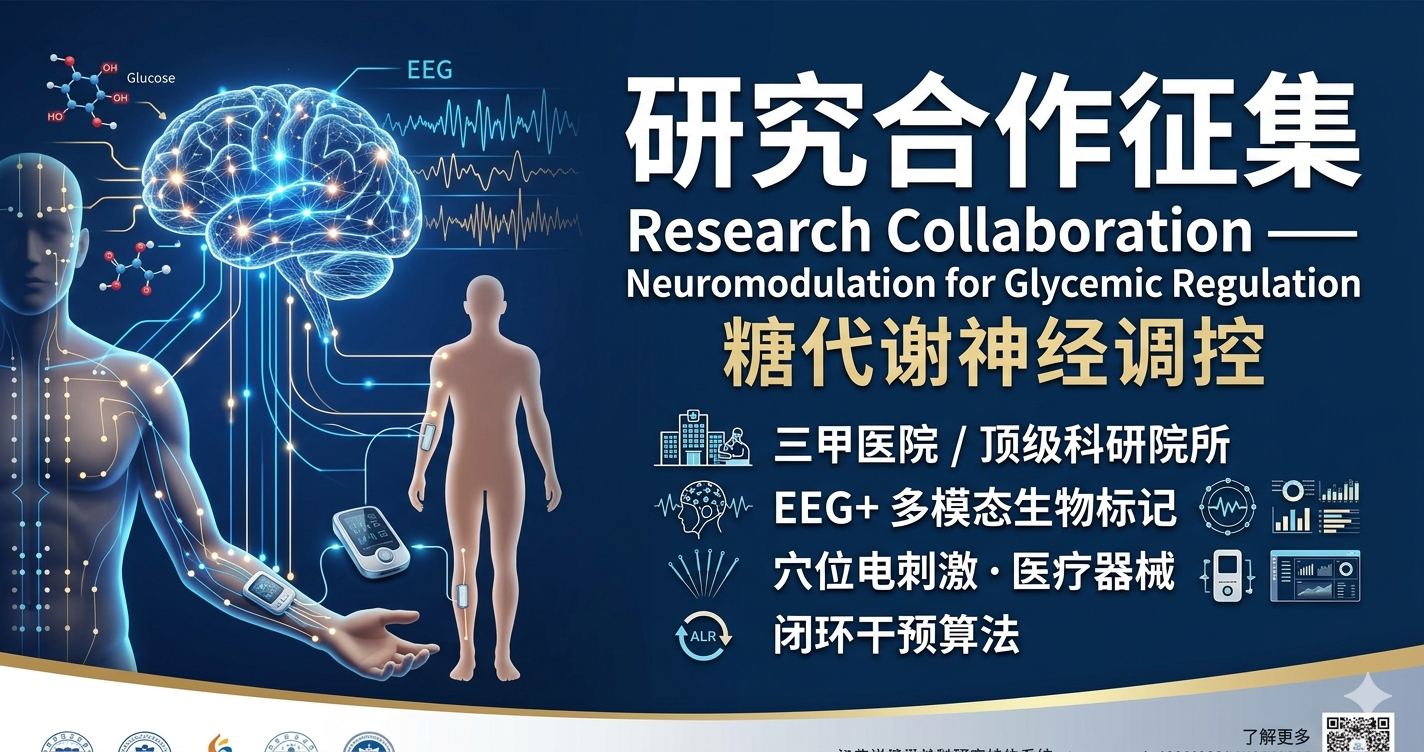
研究合作征集
糖代谢神经调控
Research Collaboration — Neuromodulation for Glycemic Regulation
Research Collaboration Call
Glycemic Neuromodulation
研究合作征集 — 糖代谢神经调控
研究背景与目标
Project Background & Objectives
糖尿病是全球慢性病负担最重的疾病之一,2型糖尿病的核心病理在于胰岛素抵抗和胰岛 β 细胞功能进行性衰退。现有药物与生活方式干预难以改变病情的自然进展。近年来积累的证据表明,自主神经系统——尤其是迷走神经和躯体神经通路——在调控血糖稳态中扮演关键角色,为神经调控干预提供了坚实的理论基础。
然而,现有研究存在三个核心缺口:(1)缺乏能够实时反映神经代谢状态的客观多维评估体系;(2)缺乏经过严格临床验证的非侵入神经调控干预方案;(3)缺乏从评估到干预的闭环反馈系统与配套可穿戴产品。
Aika Lab 正在联合具备三甲资质的医院或顶级科研院所,共同开展以下研究:
Project Background & Objectives
研究背景与目标
Type 2 diabetes remains one of the world's leading chronic disease burdens. Its core pathology — insulin resistance and progressive β-cell dysfunction — proves resistant to modification by existing pharmacological and lifestyle interventions. A growing body of evidence demonstrates that the autonomic nervous system, particularly vagal and somatic neural pathways, plays a pivotal role in glycemic homeostasis, providing a robust theoretical basis for neuromodulation intervention.
Three critical gaps persist: (1) no real-time objective multimodal assessment framework reflecting neuro-metabolic state; (2) no rigorously validated non-invasive neuromodulation protocol; (3) no closed-loop feedback system connecting assessment to intervention with a companion wearable product.
Aika Lab is seeking Grade-A tertiary hospitals or leading research institutes to jointly pursue:
① 构建基于 EEG 与多模态生物标记的糖代谢神经状态客观评估模型
② 开发并临床验证经穴位电刺激的闭环血糖调控干预算法
③ 研发支持 B端和 C端市场的配套 App + Type-C 穴位电刺激医疗附件
① Build an objective neuro-metabolic assessment model based on EEG and multimodal biomarkers
② Develop and clinically validate a closed-loop glycemic regulation algorithm via acupoint electrostimulation
③ Develop a companion App + Type-C acupoint stimulation medical accessory for both B2B and B2C markets
多模态评估体系
Multimodal Assessment Framework
评估体系的核心主张是:单一生物标记不足以捕捉糖代谢的神经调控维度。Aika Lab 提出以 EEG 为中枢神经层的核心锚点,整合外周自主神经、代谢和炎症标记,构建四维评估矩阵。
Multimodal Assessment Framework
多模态评估体系
The core premise: no single biomarker adequately captures the neural regulation dimension of glycemic metabolism. Aika Lab proposes EEG as the central nervous layer anchor, integrated with peripheral autonomic, metabolic, and inflammatory markers into a four-dimensional assessment matrix.
基于以上六层数据,构建个体化神经代谢状态评分(NMS Score):实时反映患者当前自主神经张力与血糖稳态的偏离程度,为闭环干预系统提供决策输入。模型训练目标:能够在干预前预测 HbA1c 改善可能性,识别干预响应表型。
Using the above six-layer data, build an individualized Neuro-Metabolic State (NMS) Score: real-time reflection of autonomic tone deviation from glycemic homeostasis, providing decision input for the closed-loop system. Training target: pre-intervention prediction of HbA1c improvement probability and responder phenotype identification.
闭环干预方案
Closed-Loop Intervention Protocol
干预方案的设计遵循"感知—判断—刺激—验证"四步闭环逻辑,以实时 EEG 和 HRV 信号为反馈源,动态调整穴位电刺激的频率、强度和时序参数。
Closed-Loop Intervention Protocol
闭环干预方案
Intervention design follows a four-step closed-loop logic — Sense → Judge → Stimulate → Verify — using real-time EEG and HRV signals as feedback to dynamically adjust stimulation frequency, intensity, and timing.
足三里(ST36,15Hz)· 三阴交(SP6,2–15Hz)· 合谷(LI4,2–4Hz)· 耳穴 CO10/CO14(持续低频)
ST36 Zusanli (15Hz) · SP6 Sanyinjiao (2–15Hz) · LI4 Hegu (2–4Hz) · Auricular CO10/CO14 (continuous low-freq)
ST36 Zusanli (15Hz) · SP6 Sanyinjiao (2–15Hz) · LI4 Hegu (2–4Hz) · Auricular CO10/CO14 (continuous low-freq)
足三里(ST36)· 三阴交(SP6)· 合谷(LI4)· 耳穴 CO10/CO14
① 感知层:BCI 设备采集实时 EEG(额叶 Alpha/Beta)+ 可穿戴设备采集 HRV,每 30 秒更新 NMS Score
② 判断层:算法根据 NMS Score 判断当前干预时机——识别迷走神经低张力窗口(最佳干预时机),避开不应期
③ 刺激层:App 通过 Type-C 附件输出电信号,按个体化参数刺激目标穴位,单次 20–30 分钟
④ 验证层:CGM 持续血糖监测数据作为效果反馈,自动更新下一次干预参数,形成数据积累闭环
① Sense: BCI device collects real-time frontal EEG (Alpha/Beta) + wearable HRV; NMS Score updated every 30 seconds
② Judge: Algorithm identifies optimal intervention timing — vagal low-tension windows; avoids refractory periods
③ Stimulate: App delivers signal via Type-C accessory to target acupoints with individualized parameters; 20–30 min/session
④ Verify: CGM continuous glucose data feeds back as efficacy signal; auto-updates next session parameters, completing the data accumulation loop
产品化路线图
Commercialization Roadmap
研究成果最终指向一套可商业化落地的产品体系,由 App(软件医疗器械/SaMD)和 Type-C 穴位电刺激附件(硬件医疗器械)构成,同时支持 B 端(医院、诊所、健康管理机构)和 C 端(个人家庭用户)市场。
Commercialization Roadmap
产品化路线图
Research outcomes target a commercializable product system: an App (Software as Medical Device / SaMD) paired with a Type-C acupoint electrostimulation accessory (hardware medical device), serving both B2B (hospitals, clinics, health management) and B2C (home users) markets.
配套产品规格设计
Companion Product Specification (Research Phase)
以下为研究阶段的目标产品规格设计,最终产品规格将基于 Phase 1 和 Phase 2 的临床数据确定,并依据相关医疗器械标准调整。
Companion Product Specification
配套产品规格设计(研究阶段)
The following represents target specifications for the research phase. Final specifications will be determined from Phase 1–2 clinical data and adjusted per applicable medical device standards.
| 规格项Specification | App(SaMD)App (SaMD) | Type-C 电刺激附件Type-C Stimulation Accessory |
|---|---|---|
| 产品定位Category | 软件医疗器械(SaMD)Software as Medical Device (SaMD) | 有源医疗器械,II 类(预期)Active Medical Device, Class II (projected) |
| 核心功能Core Function | NMS 评分实时显示、干预方案推送、CGM 数据联动、疗程管理Real-time NMS score display, protocol delivery, CGM data sync, treatment management | 连接手机 Type-C 口,输出经升压的电刺激信号至贴片电极Connects to phone Type-C port; delivers stepped-up electrical stimulation signal to patch electrodes |
| 输出参数Output Parameters | — | 1–30 Hz 可调 · 0–30mA · 双相方波 · 脉宽 50–500μs |
| 安全设计Safety Design | 电刺激强度确认机制、异常断电保护Stimulation intensity confirmation, abnormal disconnection protection | 过流保护、皮肤阻抗检测、电气隔离、IEC 60601-1 合规目标Overcurrent protection, skin impedance detection, galvanic isolation, IEC 60601-1 compliance target |
| 注册路径Registration Path | NMPA 软件医疗器械注册 / CE SaMDNMPA SaMD registration / CE SaMD | NMPA II 类 / 欧盟 MDR Class IIa / FDA 510(k)(后期)NMPA Class II / EU MDR Class IIa / FDA 510(k) (later phase) |
| 目标市场Target Market | B 端:医院内分泌科、糖尿病管理中心 C 端:个人家庭用户B2B: Hospital endocrinology, diabetes management centers B2C: Individual home users |
同上,须配合 App 使用Same as App; bundled use required |
Type-C 穴位电刺激附件涉及经皮电神经刺激(TENS),在中国按照 YY 0607 标准申报 II 类医疗器械,在欧盟按 MDR Annex II 申报 Class IIa,在美国可参考 FDA 510(k) 路径(K 号,TENS 类)。临床数据包的建立是注册申报的关键路径,本合作研究将直接为注册提供核心证据。
The Type-C acupoint stimulation accessory involves transcutaneous electrical nerve stimulation (TENS). China registration under YY 0607 standard (Class II); EU registration under MDR Annex II (Class IIa); US via FDA 510(k) pathway (TENS category, K-number). The clinical data package from this collaboration will directly serve as core evidence for regulatory submissions.
循证基础
Published Evidence Supporting This Research Direction
以下数据摘自已公开发表的系统综述和 Meta 分析,是本研究方向的科学依据基础。
Published Evidence Base
循证基础
The following figures are drawn from published systematic reviews and meta-analyses supporting this research direction.
合作模式与各方职责
Cooperation Model & Responsibilities
Cooperation Model & Responsibilities
合作模式与各方职责
- 提供 EEG BCI 设备及穴位电刺激硬件原型(研究专用)Provide EEG BCI devices and acupoint stimulation hardware prototypes (research use)
- 提供加密的评估算法和干预算法引擎Provide encrypted assessment and intervention algorithm engines
- 提供 App 研究版本及数据管理平台Provide research App version and data management platform
- 负责算法迭代优化和技术支持Lead algorithm iteration and provide technical support
- 主导产品化推进及医疗器械注册申报Lead commercialization and medical device registration
- 承担相应比例的研究经费Bear proportional research funding
- 提供内分泌科、神经内科或中西医结合科的临床研究平台Provide clinical research platform in endocrinology, neurology, or integrative medicine
- 负责 IRB 伦理审查申请及受试者招募Handle IRB ethics applications and participant recruitment
- 配备具备临床研究资质的主要研究者(PI)Assign qualified Principal Investigator(s)
- 开展规范化数据采集(六层生物标记,含 CGM)Conduct standardized six-layer biomarker data collection (including CGM)
- 参与研究成果的学术发表与学术交流Participate in academic publication and dissemination of findings
- 优先参与多中心 Phase 3 临床试验Priority participation in Phase 3 multi-center trial
具备三甲医疗资质的综合医院(内分泌科、神经内科、中西医结合科);或具备临床研究能力的医学院附属医院、国家级重点实验室;具备 IRB 审查资质,已有糖尿病队列研究经验者优先。欢迎国内及欧洲机构共同申请。
Grade-A tertiary hospitals with endocrinology, neurology, or integrative medicine departments; or academic medical centers and national key laboratories with clinical research capability. Priority to institutions with existing diabetes cohort experience and in-house IRB. Domestic Chinese and European institutions welcome.
知识产权与成果分配
Intellectual Property & Outcome Attribution
Intellectual Property & Outcome Attribution
知识产权与成果分配
伦理与安全要求
Ethics & Safety Requirements
Ethics & Safety Requirements
伦理与安全要求
鉴于本项目涉及糖尿病患者的干预性研究,双方特别约定以下安全条款:
- 所有受试者在研究期间须维持原有降糖药物治疗,穴位电刺激作为辅助干预而非替代治疗
- 试验中如出现低血糖(血糖 <3.9 mmol/L)事件须立即记录并向双方报告
- 心脏起搏器植入者、妊娠期妇女、活动性皮肤损伤部位为绝对排除标准
- 研究须遵守《赫尔辛基宣言》及 ICH-GCP 临床研究规范,所有受试者须签署知情同意书
Given the interventional nature of this study with diabetic participants, the following safety provisions apply:
- All participants must maintain existing hypoglycemic medications; acupoint stimulation is adjunctive, not replacement therapy
- Hypoglycemic events (blood glucose <3.9 mmol/L) must be recorded immediately and reported to both parties
- Absolute exclusion criteria: cardiac pacemakers, pregnancy, active skin lesions at stimulation sites
- Research must comply with the Declaration of Helsinki and ICH-GCP; written informed consent required from all participants
意向书条款
Letter of Intent Terms
本意向书有效期两(2)年。双方同意在签署后九十(90)日内完成正式合作协议谈判与签署。任何一方可提前三十(30)日书面通知终止本意向书。除保密义务及伦理安全条款外,本意向书不构成具有法律约束力的合同。本意向书适用瑞典王国法律,争议提交哥德堡商事法庭裁决。中英文版本具有同等法律效力,两版本不一致时以中文版为准。本意向书一式四(4)份,双方各持两(2)份。
Letter of Intent Terms
意向书条款
This LOI is valid for two (2) years. Both parties agree to complete formal agreement negotiations within ninety (90) days of signing. Either party may terminate with thirty (30) days' written notice. Except for confidentiality and ethics/safety provisions, this LOI is non-binding. Governing law: Kingdom of Sweden; disputes to Gothenburg Commercial Court. Both language versions have equal validity; Chinese prevails in case of inconsistency. Four (4) counterparts; two (2) each.
签署栏
Signatures
Aika Lab
Stay updated
Get notified when we publish new research on sleep neuroscience and BCI.